Craft Anything: AI rebuilds any app? —
the catch? It's early alpha, and it runs as you
Craft Anything is an open-source, clean-room engine in pure Rust that studies a website, app or game you can see, then has AI build your own version — Study, Build, Check, Ready. The catch: early alpha, your own Claude Code sign-in, and it's not a sandbox or a legal pass.
- Claim
- ANY APP, AI-BUILT CLONE?
- Catch
- EARLY ALPHA
- Verdict
- REAL REBUILDS, fine print attached
Eight thousand nine hundred sixty-two stars in four days. That's what GitHub's API shows for storytold/craft-anything as of 4 November 2026 — a repo created on 31 October 2026 that pitches an open-source, clean-room engine in pure Rust: "See how any software works, then have AI build your own version."
The pitch, in the README's words: point it at a target, say what you want ("Recreate this website", "Recreate this game's gameplay in Rust"), and it studies the original with real inspection tools, has a coding agent build a new project, checks the result against the original and refines it. A live run logged by the project itself (18 October 2026, Windows 10, headless CLI) reached Ready at 96% likeness on a website clone in 1.5 minutes; a small Rust+egui app reached Ready in 9 minutes (checked only by building); a game rebuild reached Build and was stopped before Check. Treat those as the project's self-report — we did not reproduce them.
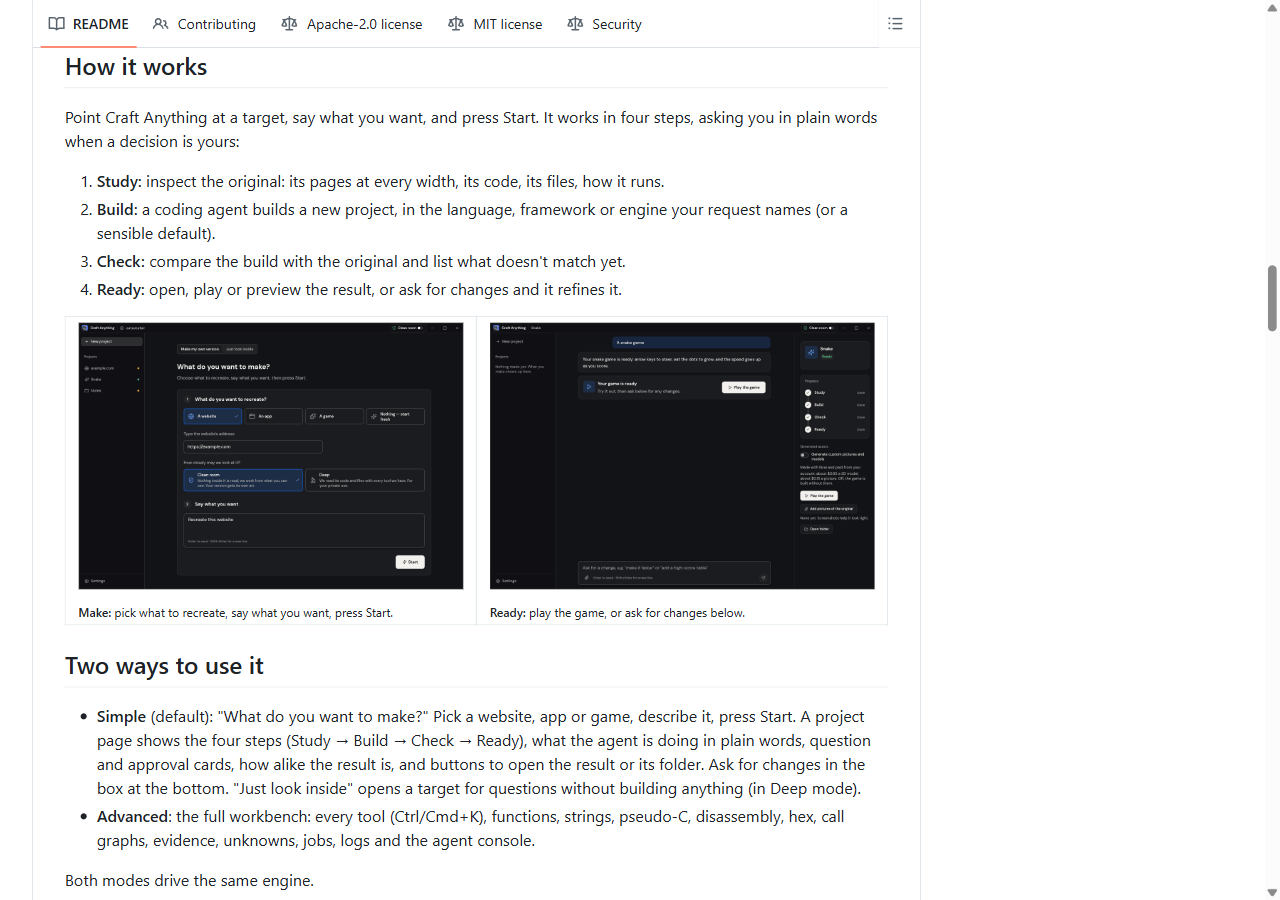
How a rebuild runs
The README describes four steps, and it asks in plain words when a decision is yours:
- Study — inspect the original: its pages at every width, its code, its files, how it runs.
- Build — a coding agent builds a new project, in the language, framework or engine your request names (or a sensible default; Rust + egui for apps, Unity for games, the original's own for websites).
- Check — compare the build with the original and list what doesn't match yet. Websites are compared at 1440, 768 and 390 px; up to 6 refinement rounds, or until 90% likeness.
- Ready — open, play or preview the result, or ask for changes and it refines it.
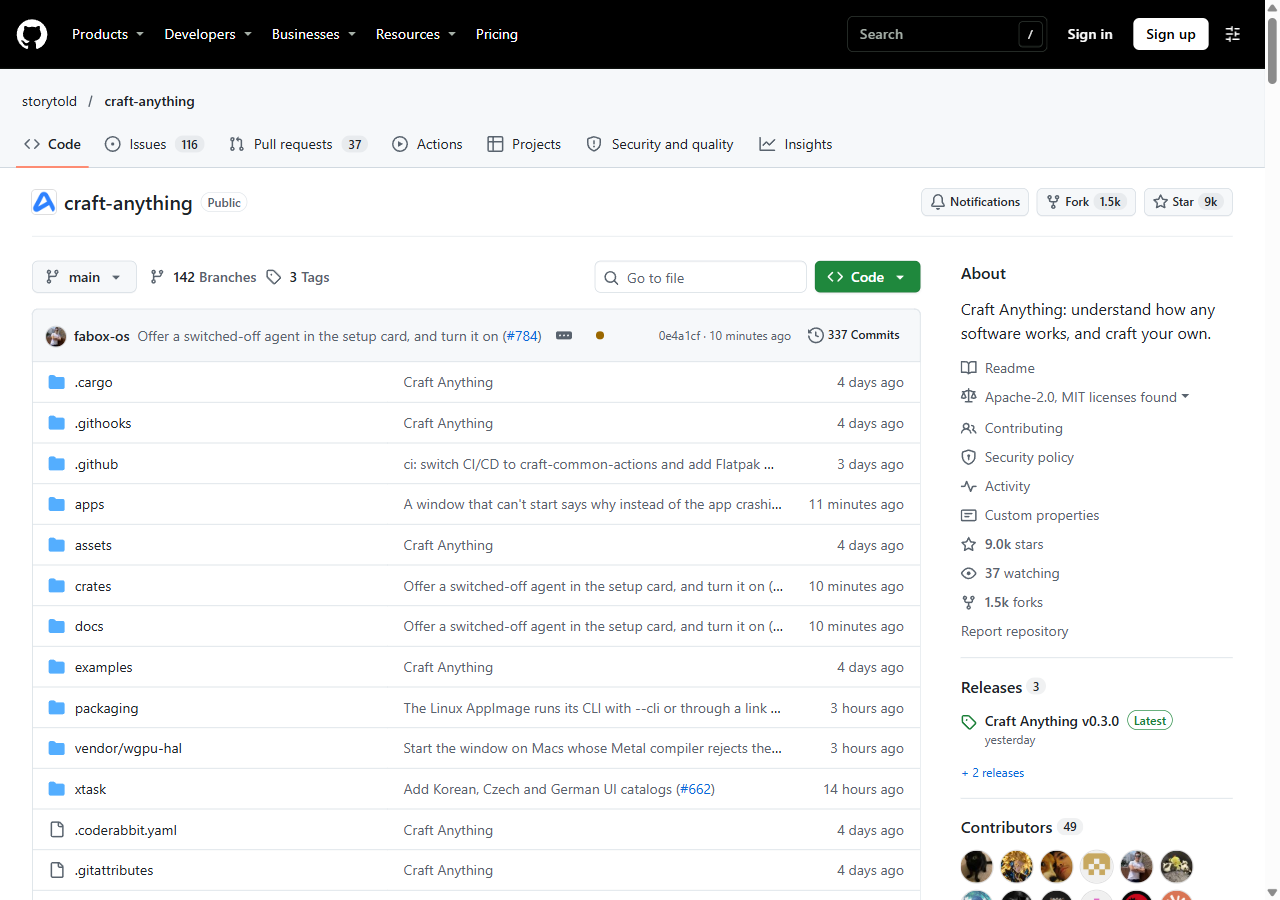
Clean room is the default and the interesting part: it never reads anything inside the original — not its code, files, or page source. It works from what a visitor can see: pictures you add, the website as a visitor sees it (screenshots, visible text, measured layout, colours, fonts, spacing, menus opened) and, with your allowance, a picture of the app's window. Tools that would look inside are refused in Clean room; Deep mode uses every tool, for your private use, including the built-in engines and Ghidra when it's installed.
Under the hood there are 320 tools (300 in the engine, the rest from the AI and setup layers), each a CLI command and an MCP tool, so any coding agent can drive the same engine the app uses. MIT or Apache-2.0. Rust 1.97+ to build from source; installers for Windows, macOS, Linux and FreeBSD on the Releases page.
What the fine print says
Building needs a coding agent signed in on your computer. Claude Code is supported first: Craft Anything runs your own, unmodified claude program, which uses your own sign-in — Craft Anything never sees or handles your account. Your use of it falls under your own agreement with Anthropic. A Codex adapter exists but hasn't been verified on a real install; GitHub Copilot can use your installed Copilot CLI through ACP; other ACP agents (Gemini CLI, Qwen Code, opencode, goose, Hermes, Maki) are switchable per backend, and of those only Maki has been run live (2 November 2026, Linux, headless CLI: a static page built to Ready in 38 s). No live API-key build yet.
The catch
Clean room is a rule, not a wall. The README says it plainly: it is not an operating-system sandbox and it doesn't isolate your computer. A coding agent you run still acts as you, and what it can read, write or run depends on its own permissions. It's for software you own or are allowed to examine, and it never bypasses DRM, logins or anti-cheat. Rebuilds recreate layout, style and behaviour from evidence; the agent is told not to copy logos, photos or text unless you confirm you own them or have permission.
It's early alpha. The status badge says so, v0.3.0 (2 November 2026) is the latest release, and the audit log in docs/STATUS.md is open about what isn't verified: no live Clean room build has been run yet, other agents are partially verified, and local-model builds don't work — four live CLI builds on an RTX 5090 (4 November 2026, qwen2.5-coder:14b) compiled but still left cargo's "Hello, world!" as main.rs, failing the screenshot check at the round limit. And installing dependencies runs code: npm runs each package's install scripts by default, so only approve command kinds and projects whose dependencies you trust.
Verdict
Craft Anything is a real, unusually honest attempt at clean-room rebuilding, and the engineering is open for anyone to read — but it's an early-alpha experiment that runs as you, on your sign-in, against software you may examine. Used within those limits, it's worth watching. Used to clone software you have no right to, it was never the tool's promise.
Sources: github.com/storytold/craft-anything (README, Releases v0.3.0, 2026-11-02) · docs/STATUS.md (its own audit log, updated 2026-11-04; live run, Clean room and local-model limits) · GitHub API, 2026-11-04 (8,962 stars, 1,488 forks, created 2026-10-31, Rust, MIT/Apache-2.0) · docs/claude-code.md
SOURCES
THE CATCH BY EMAIL
Get the catch by email
One short email a week: the viral claims we checked, what the sources really say, and the catch. No spam, unsubscribe in one click.
Free. Sent through Buttondown. Privacy


