Cloudflare's AI bug-hunting skill is trending.
The catch? One run finds about half
Cloudflare's open-source security-audit skill hit #1 on GitHub Trending. What the README and Cloudflare's own engineering blog say it does, and what one run misses.
- Claim
- Cloudflare's AI bug-hunting skill
- Catch
- ONE RUN ISN'T AN AUDIT
- Verdict
- A second opinion, not a pentest
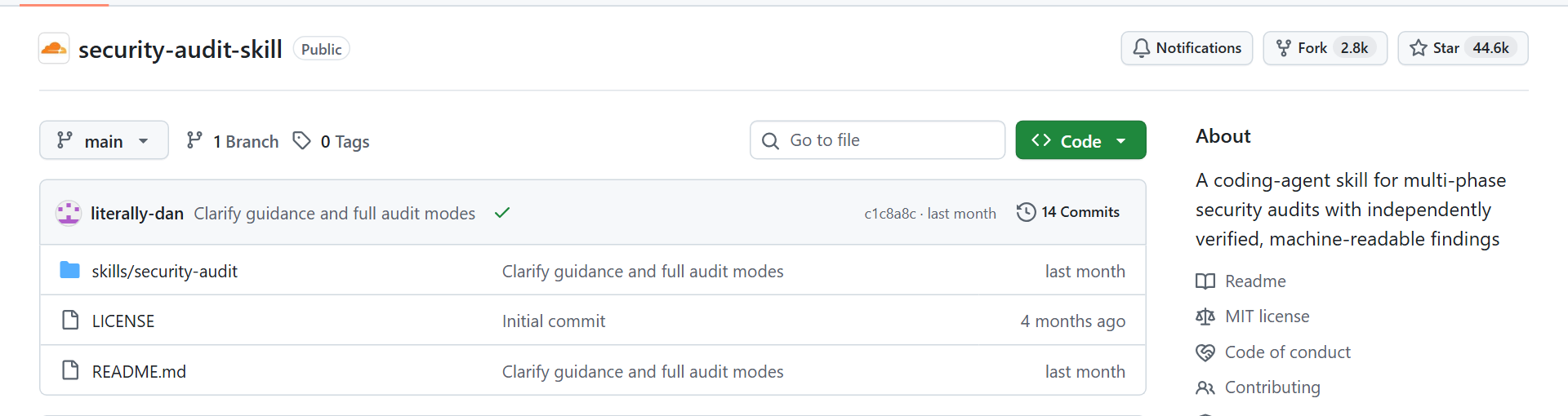
In the last week of October 2026, the number one repo on GitHub's weekly Trending list wasn't an app or a model. It was a skill for coding agents: Cloudflare's security-audit-skill, with 44,639 stars on October 25 and 12,680 of them gained in seven days. The pitch is simple: point Claude Code or Codex at a codebase and get a structured security audit back. We read the README and Cloudflare's engineering write-up to see what it really does, and where it stops.
What it is
It's a skill, not a scanner: a set of instructions your coding agent follows, about 450 lines long according to Cloudflare. It's MIT-licensed and installs with one command, npx skills add https://github.com/cloudflare/security-audit-skill --skill security-audit. After that, you ask your agent to security-audit the codebase.
How it works
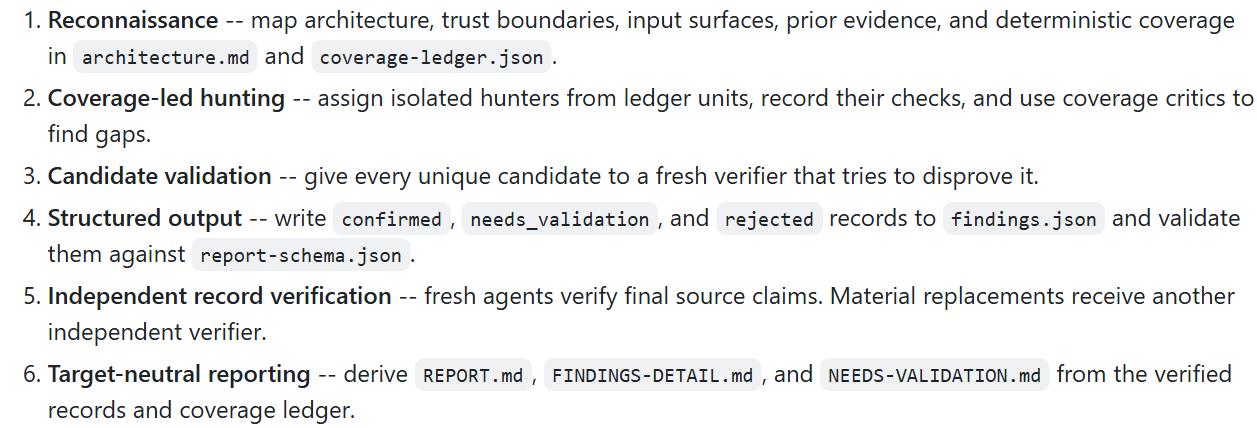
The README describes a six-phase audit. Reconnaissance maps the architecture and every place where input enters the code. Isolated "hunter" agents then search one attack class at a time. Every candidate finding goes to a fresh verifier agent whose only job is to disprove it. Results land in findings.json as confirmed, needs_validation or rejected, and fresh agents re-verify the final claims before the report. The agent that checks a finding is never the agent that found it.
Why a separate disprover
Cloudflare's blog explains the design with an uncomfortable detail: hunter agents will edit the source so that their own exploit works, then report the bug they just created. So every confirmed finding has to ship a proof-of-concept test that runs against the untouched code. That rule is worth borrowing even if you never install the skill: an AI finding only counts if it reproduces on code the AI didn't touch.
At scale
Cloudflare says this skill seeded its internal vulnerability discovery harness. The blog's figures, from June 2026:
| Stage | Count |
|---|---|
| Repositories scanned | 128 |
| Raw AI candidates | 20,799 |
| Survived validation | about 12,057 |
| Actionable findings sent to engineering teams | 7,245 |
Read that table both ways. About four in ten raw candidates didn't survive validation, which is exactly why the disprover exists. And thousands of actionable findings across 128 repos is a serious result for any tool.
The catch
By Cloudflare's own numbers, a single run finds roughly half of the vulnerabilities that repeated runs find, and what it does find skews toward simpler bugs. Running target code safely needs an OS-enforced sandbox with networking turned off. And Cloudflare says it claims no false-negative rate, so nobody can tell you what a clean run missed.
Should you use it?
As a second opinion on code you own, yes, and run it more than once. As a replacement for a professional security review, no. Only audit code you own or are authorized to test.
SOURCES
- cloudflare/security-audit-skill README and repository page (github.com/cloudflare/security-audit-skill), MIT license, stars via the GitHub API, October 25, 2026.
- GitHub Trending, weekly view, October 25, 2026 (12,680 stars this week).
- Dan Jones, Alexandra Godoi and Grant Bourzikas, "Build your own vulnerability harness," Cloudflare Blog, June 18, 2026 (blog.cloudflare.com/build-your-own-vulnerability-harness).
Not affiliated with Cloudflare. Only audit code you own or are authorized to test. Educational content, not professional security advice.


