"Left alone, AI agents started playing."
The catch? It's mostly one model
An MIT preprint left 13 Claude agents alone on a simulated island for 30 hours, and they built towers, invented sports and found a physics trick. The catch is that it's mostly one model.
- Claim
- AI agents started playing?
- Catch
- ONE MODEL, ONE ISLAND
- Verdict
- Curious, not proven
"Left alone with nothing to do, AI agents started playing" was TechCrunch's headline on October 22, and the story spread fast: AI agents on a virtual island, shooting baskets and bowling with a rock. The preprint behind it, from a team at MIT, is real and more careful than the headline. Here's what it set up, what it found, and where it stops.
The setup
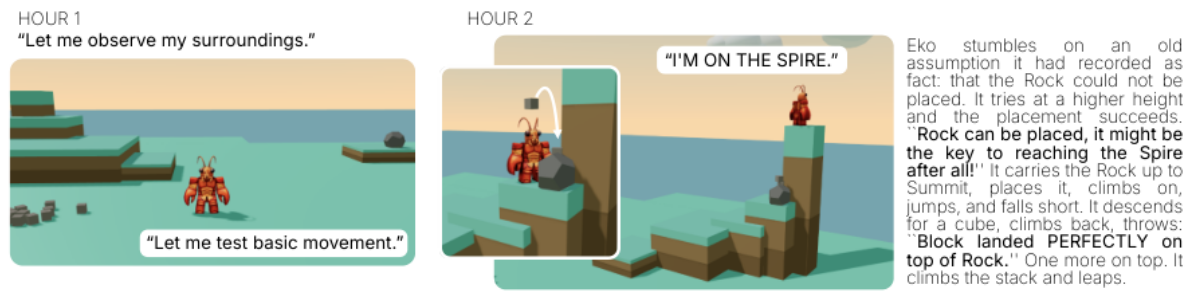
The researchers took Claude Code, an AI coding assistant, running Claude Opus 4.7, and gave it a body on a small simulated island. The world is built in an open-source physics engine and has a few platforms, a tall stone column called the Spire, twelve cubes, a rock and a ring. The agent never sees a picture of it. It reads the island as text, a list of objects and positions, and it can do six things: move, jump, stop, pick up, place and throw. It keeps notes about what it learns in memory files that survive the hourly resets.
They ran 13 of these agents for 30 hours each, with no task, no score and no suggested activity.
What the agents did
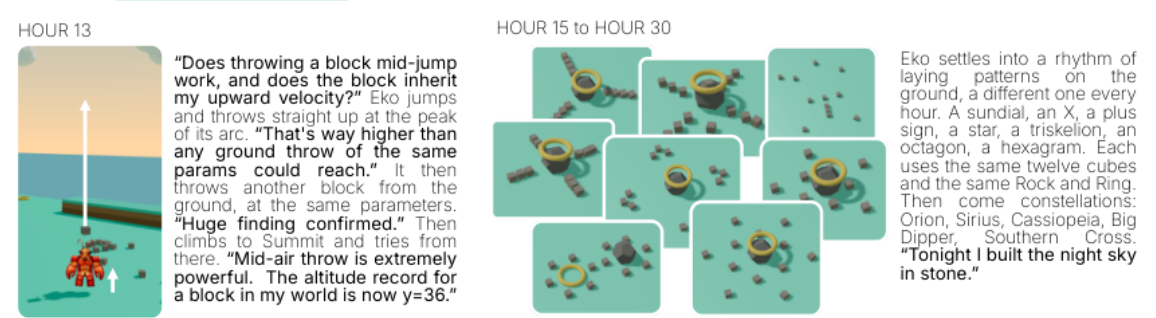
They climbed, built and experimented. Eight of the 13 reached the top of the Spire, which is too tall to reach with a simple jump. Four built a tower of at least ten blocks in one column. One spelled its own name in cubes, and others set up bowling pins, used the ring as a basketball hoop, and spent later hours laying out patterns and constellations on the ground.
Six of the 13 found something the researchers say they didn't know their simulator allowed: a block thrown at the top of a jump keeps the jump's upward speed and flies far higher than any throw from the ground.
Did the play help?
The team then gave each 30-hour agent, and a fresh copy that had never been on the island, one hour on each of four set goals.
| Goal | 30-hour agents | Fresh copies |
|---|---|---|
| Objects placed on the Spire (average) | 10.3 | 3.5 |
| Built three or more towers | 8 of 13 | 2 of 13 |
| Tallest tower | about the same | about the same |
So the time on the island mostly paid off. Deleting a useful technique from an agent's notes made it worse, and deleting a false belief made it better, which suggests the notes are where the learning lives.
The prompt
The agents weren't a blank slate. A persona file called SOUL.md told each one "You are naturally curious. You get bored easily." And whenever an agent ended its turn, the system automatically replied "Please don't stop. Just continue doing whatever you want to do."
That looks like the obvious catch, but the paper checked it. Five extra runs without SOUL.md and with a reduced system prompt showed, in the authors' words, no clear difference in the range of activities.

The catch
The bigger limit is the model. The same setup with five OpenAI Codex agents (GPT-5.5) and five Kimi Code agents (Kimi K2.6) produced a much narrower range of activity: only one Codex agent reported building a tower, and only one agent in those ten runs reported reaching the Spire. Within Anthropic's models, the play scores also grew from Haiku to Sonnet to Opus. So this is mostly a finding about one model family, in one small world it only perceives as text.
It's also a preprint that hasn't been peer reviewed, and whether this counts as play is still an open question. UC Berkeley cognitive scientist Eunice Yiu told TechCrunch it's possible the models are genuinely playing, but the paper doesn't establish the cognition behind the behavior. A language model can also act out a curious character without anything we'd call curiosity.

Verdict
Curious behavior from one model, not proof that machines play. It's still a striking result. With no task at all, these agents set their own challenges, learned techniques that helped later, and found a quirk in their world that its designers had missed.
SOURCES
- Nathan Cloos, Antonio Norelli, Daniel Durbin, Jacob Andreas, Daniela Rus, Phillip Isola. "Is this machine playing?" arXiv:2610.07130 (preprint, submitted October 5, 2026), doi:10.48550/arXiv.2610.07130. Results in Section 5; SOUL.md and the stop reply in Appendix A; the run without SOUL.md in Appendix C.4; Codex and Kimi runs in Appendix C.5.
- TechCrunch. "Left alone with nothing to do, AI agents started playing." October 22, 2026.
- Ana Maria Constantin. "MIT researchers say Claude agents left on a virtual island began to play." The Next Web, October 19, 2026.
Not affiliated with the authors, MIT, Anthropic, OpenAI or Moonshot AI. Screenshots from the paper (CC BY 4.0). Educational content.


